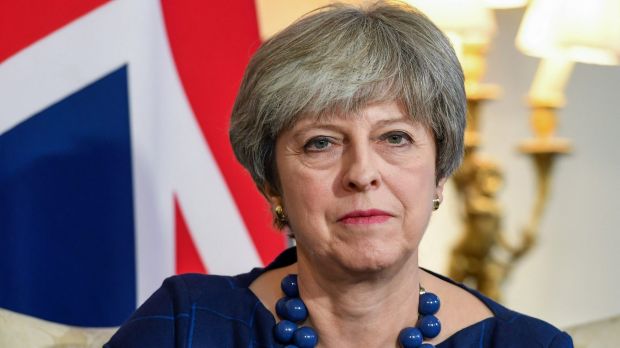
Showing posts with label Theresa May. Show all posts

The conservative weekly "The Spectator" is influential - and widely read - in Conservative Party circles, so it can hardly be good...


The conservative weekly "The Spectator" is influential - and widely read - in Conservative Party circles, so it can hardly be good news for May that its well-connected political editor, James Forsyth, has written the cover story under the stark demand that she "Lead or Go".

This debate doesn't seem to be getting any quieter, even as May is in China trying to secure trade deals.  The BBC's Laura Kuenssberg commented on the febrile atmosphere in Westminster on this morning's Today programme (here, go to 1:09:06 for Nick Robinson's start), noting that Tory MPs were daily changing their minds about May.

The problem for Tory MPs, as I noted below and here, is their risk-averse caution.  They don't want May but they hate the uncertainty of the alternative.  May's leadership is flawed from top to bottom, but the parliamentary part she leads is riven through and through with factional strife, resulting in a ghastly stasis that is tipping the party into a state of catatonic inaction.

Michael Oakeshott was the pre-eminent 20th century philosopher of conservatism, and his analysis of 1951 might bear some re-considering.  He described conservatives attitudes thus:

In political activity, then, men sail a boundless and bottomless sea; there is neither harbour for shelter nor floor for anchorage, neither starting-place nor appointed destination. The enterprise is to keep afloat on an even keel; the sea is both friend and enemy

Tory MPs today might want to consider whether they have taken to heart his final injunction:

The seamanship consists in using the resources of a traditional manner of behaviour in order to make a friend of every hostile occasion.

They are certainly facing a hostile occasion, but don't yet seem to have secured the resources to make a friend of it.  Very unconservative.


Like Mark Twain’s death, reports of Theresa May’s demise have been greatly exaggerated. Unlike the legendary writer’s death rumours, however...


Image result for theresa mayLike Mark Twain’s death, reports of Theresa May’s demise have been greatly exaggerated. Unlike the legendary writer’s death rumours, however, these are more frequent and relentless. Quite how a person of little obvious political skill or charisma, and seemingly little personal support, has managed to soldier on in Britain’s highest political office during a period of more or less consistent crisis, will be as much a matter for political psychologists as historians in the future.

For now, it is enough to occupy ourselves with the return of that perennial British favourite, “Will Theresa Survive?” When she’s not dealing with a crisis of her own making, be it a misjudged election, a botched reshuffle, or the failure to call yet another errant minister to account, Britain’s accidental Prime Minister is usually to be found fire-fighting another round of leadership questions. Or not. The odd thing about these regular leadership issues is just how little we hear from the central figure, Mrs. May herself. Questions are asked, searing articles are penned, a sense of impending crisis is adopted, and some poor soul is shuffled in front of the cameras to make whatever limited case he or she can for the prime minister before the crisis seems to pass. The lady herself, with her pursed lips and dull, thudding phraseology, is nowhere to be seen.

Mrs. May has managed to prove the success of what is in reality a very simple political strategy. Just keep soldiering on. What is often underestimated in analyses of politicians in their insulated environment is just how little radicalism or courage they are willing to show. Caution is the best observed watchword in any political town, and no more so than in Britain’s scarcely beating political heart of Westminster. Most leaders subjected to the sort of crisis-ridden term that Theresa May has had, coupled with the relentless criticism, would have decided to either try and lance the boil with a leadership election ( a tactic once tried by John Major, which saw him re-elected but notably failed to do much lancing) or simply stand down from sheer weariness and stress. Not for nothing is Mrs. May known as the “Maybot”, a term coined by the Guardian’s political sketch writer John Crace. She really does act like some advanced form of AI which has been programmed to go through the motions of Brexit negotiations and will not be distracted from this key task by mere notions of human frailty. Only utter destruction will stop the Maybot in its tracks.

Whether such utter destruction is just round the corner is not yet fully established, but there have once again been rumblings of discontent in Westminster about her leadership. Newspapers report that the chairman of the Conservative backbenchers committee (known as the “1922” committee after the seminal moment in that year when Tory MPs ousted former war leader David Lloyd George) has received nearly enough letters from MPs to spark a leadership election. Commentators have also been dusting off their familiar critiques of the Prime Minister – that she lacks vision, is indecisive, has no idea of what she is doing vis a vis Brexit and cannot control her ministerial colleagues. And her two principal cabinet colleagues, the Foreign Secretary and the Chancellor of the Exchequer, have once again been sparring in public and producing their own versions of government policy.

There are few certainties about any of this other than that Mrs. May will never step down voluntarily, whatever the pressure. When you’ve weathered the sort of disastrous and self-inflicted election defeat that she has, and moreover proved manifestly and publicly incapable of clear leadership on the central issue facing Britain today (Brexit), and still insist on staying in office, you can guarantee nothing else is going to come along to shake that extraordinary self-belief.

The issue is less about Mrs. May now and more about her critics and putative rivals. It isn’t just caution that holds Conservatives back from igniting a leadership election whilst being in a precarious minority government. Both sides are fearful of the alternative. So-called “Remainers” see Mrs. May in all her awkwardness as palpably more acceptable than the flamboyant charlatan Boris Johnson, once again a likely prospect to triumph in a leadership election. The “hard Brexiters” meanwhile worry about the outside prospect of a Remain leader such as Home Secretary Amber Rudd or Defence Secretary Gavin Williamson. There is also the chance that they know the political damage that could well come with the sort of “hard Brexit” they are advocating, and prefer someone else to take the fall.

It is certainly conceivable that Theresa May could well still be prime minister when the Brexit deal – in whatever form – is signed and sealed in 2019. But Remainers in particular might want to consider the advantage of letting full blooded Brexiters have their day in dealing with the turbulent negotiations of the Treaty they campaigned so fulsomely for. Trying to limit the treaty, or make it look like we haven’t really left, may sound like a comforting strategy, but it will leave Remainers on the defensive and give the hard Brexiters a stick with which to beat them for many years to come. If the referendum result is to have any chance of lancing the anti-EU boil and bringing some harmony to the Tory party, it may be best to ditch Mrs. May and give Boris and his ragtag army of true believers full reign.

If you thought Theresa May was tone-deaf and unresponsive during the actual election campaign, then that's nothing on her performance si...

If you thought Theresa May was tone-deaf and unresponsive during the actual election campaign, then that's nothing on her performance since.

Following her seriously reduced circumstances I initially thought it was right for her to continue in office.  The electoral arithmetic suggested it as the only viable option, at least until the parliamentary circumstances changed.  She could have chosen to take on board the disastrous result that her cavalier election calling produced and govern as a minority leader but with significant consultation with other parties on Brexit.  That her own Brexit stance - which has been irredeemably, if unilluminatingly of the "hard" variety - would need modifying seemed evident too.

Then came the day after.  The prime minister's speech outside Downing Street was one of the most misjudged exercises I have come across.  She made no reference at all to the lamentable election result.  She simply announced she would be forming a new government, and for good measure she replaced the old "strong and stable" with the word "certainty".  I began to wonder if somehow she had been kept isolated from the election results.  It was a performance of astonishing misjudgement and ineptitude.  Compare it with David Cameron's eloquent and moving "mea culpa" after the referendum.  So utterly disconnected was her speech that she had to follow it up with a hurriedly organised television interview in order to "apologise" to all of the Tory MPs who had lost their seats thanks to her calamitous campaign.

More than anything else, this speech captured exactly why Mrs. May must not be allowed to carry on as prime minister.  The speech bespoke an absolute determination to ignore any circumstances that don't suit her.  It shed light on Mrs. May's utter inflexibility.  Here was someone who was so myopic and incapable that she couldn't even acknowledge the earth-shaking circumstances that everyone else was talking about and which had brought her to this pass in the first place.  She couldn't move from her script.  She couldn't develop a quick response to her massively changed circumstances.  She couldn't find it within herself to express any sort of empathetic understanding to her disappointed supporters and allies.

And if she couldn't do this simple task, part of the basic toolbox of political leadership, then how on earth could we expect her to manage the infinitely more challenging unpredictable and difficult Brexit negotiations?

I thought originally that Theresa May should stay and provide some continuity in difficult times, even if those times were largely of her own creation.

Now it seems to me that if we are to have any chance of a successful start to our increasingly unwanted and unloved Brexit negotiations, then Theresa May has to be replaced immediately.  All those foolish Tories who think she will be able to open such negotiations with imagination and flexibility, who have you been listening to?  For Theresa May, alarmingly and bizarrely, "nothing has changed".  This is a woman who can row back on a policy and claim it is the same one.  That level of delusion has now been extended to some sort of weird understanding of the election that suggests it has said nothing of value to her.

The Tory Party may be in a bind because of the lack of top rate talent in its upper echelons, but at the moment almost anyone - obviously excluding Liam Fox - would be better than the delsuional, mad force currently in charge.  Instead of ringing their hands and moaning about her advisers, Tory MPs should step up to the moment and actually try and serve their country.  And they should do it by providing new and better leadership.  If they do, in time we might forgive them for the Mayist aberration.


1.  Don't take the electorate for granted.  Theresa May's party (she abdicated the Conservative name for the duration) did this twic...

1.  Don't take the electorate for granted.  Theresa May's party (she abdicated the Conservative name for the duration) did this twice.  It assumed everyone would ignore the opportunistic nature of the election, and that they would then happily respond to a patronising campaign of empty slogans.  Turns out they didn't.

2.  Every vote matters, even under First Past the Post.  Young voters complained about Brexit, but their complaints carried little weight given the fact that many didn't vote in that ill conceived referendum.  This time they voted, and the change has been palpable.

3.  Traditional campaigning still matters.  Theresa May's party thought they could win this with a big data machine and by programming, without variation, key phrases into the political dialogue.  They thought they could avoid real voters with impunity, whether in televised debates or in the streets.  Jeremy Corbyn suffered a media monstering, but built up support through a consistent round of old fashioned rallies.  Crowds matter, it seems, and he was able to appeal to a decent proportion of the electorate through these rallies.  We're a democracy, and he met people.  Somehow it seems to work.

4.  Manifestos should not be insulated efforts.  Whatever the fine aims of Theresa may's manifesto, it was drawn up quickly by a tight group of May loyalists who failed to road-test it within the wider party.  It then backfired.  Surprised?

5.  Leaders should be able to campaign.  As everyone is noting, this election was entirely the product of Theresa May's desire.  There was no reason at all to call it, and certainly not the one she gave.  In consequence, though, one might have expected her to show some campaigning vigour and ability.  Alas, when calculating her election gamble, she failed to factor in her own dislike of campaigning.

6.  When you have a venerable party with all its traditions and brand, use it.  Theresa May's team confined the party name to a footnote and insisted that all of her candidates do the same on their official campaign literature.  Prospective MPs once called Conservatives simply became people "standing with Theresa May".  Once the electorate decided they had their doubts about Theresa May, there wasn't anywhere else to turn.

7.  We are a parliamentary system, not a presidential one.  See 6 above and remember that for all the dominance of party leaders, constituency candidates do still stand on their own merits as well.

8.  The "vision thing" still matters.  When all was said and done, there wasn't much of a discernible vision behind the May campaign.  "Brexit means Brexit" was as empty a slogan as has ever been uttered on a campaign trail, coming as it did with absolutely no enhancing narrative or vision at all.  Compare that with Labour's ability to appeal to a range of people with a clear vision of what needed to be done for Britain.  Agree with it or not, it gave the impression they were thinking about what to offer.

9.  Personalities are important.  Theresa May would have obviously been a dominant figure even without the quasi-presidentialism of her campaign. just as Jeremy Corbyn was on the other side.  The problem for May is that she failed to project any warmth or spontaneity and appeared to actively avoid contact with ordinary voters.  In a modern democracy it isn't possible for a leader to survive without a decent skill at communications.  May utterly lacked that.  Contrast her with the cheerful and positive Ruth Davidson, leading something of a Tory revival in Scotland.

10.  Is politics being re-set?  There is a case for this.  The election has seen the return of two-party politics, the effective icing of another Scottish independence referendum, and the likelihood of a more pragmatic, Europe friendly Brexit.  Are we coming through a nightmare period, for all the veneer of chaos that exists today?

The problem with examining Conservative Party divisions is that we tend to still be using out of date terminology.  The party has moved on f...

The problem with examining Conservative Party divisions is that we tend to still be using out of date terminology.  The party has moved on from a Thatcherite/One Nation division (if it ever really existed in one) not least because the times have changed.  No Conservative leader seriously disputes the need to maintain Thatcherism's principal legacy of a privatised economy and lower taxes (a legacy that even social democrats like Tony Blair undertook to essentially preserve).  The headline issue that split the Conservatives in the post-Thatcher years was Europe, although there was also debate around liberal versus conservative social attitudes and the extent to which public services like health and education should be submitted to the rigours of free market medicine.

The key to determining the direction of the Conservative party lies with its leaders and the best way of understanding Conservative divisions is probably via them.  Unlike its main rivals, the Conservatives are driven to an extraordinary degree by the men and women who lead it.  While Conservative grassroots members are broadly right-wing, often putting them at odds with more liberal minded leaders, they are also fundamentally loyal.  They do not have pretensions to directing the parliamentary party, even if they now expect a say in how it is led (although such a say is rare - only Iain Duncan Smith and David Cameron became leaders as a result of a grassroots vote).

Party historians date the Conservative Party back to either Robert Peel or William Pitt the Younger.  Pitt embodied the free trade philosophy that has remained part of the party's policy DNA (leading to a substantial internal divide at the beginning of the twentieth century) while Peel was an early social reformer.  Peel's cabinet included William Gladstone while his backbench MPs included Benjamin Disraeli.  Gladstone took his economic liberalism to the Liberal Party after the repeal of the Corn Laws split the party, while Disraeli eventually came to articulate what he called a One Nation vision for the Conservatives.

One Nation Conservatism - a somewhat inchoate, pragmatic blend of paternalism and specific government action to benefit the working poor in the interests of national harmony - came to dominate the Conservative Party for much of the twentieth century.  However, it was encountering problems under Edward Heath and it fell to Margaret Thatcher to provide something hitherto unknown for Conservatism - an ideology.  The liberal conservative Ian Gilmour had noted that "the wise Conservative travels light" but such lightness of travel wasn't benefiting them by the 70s, so Mrs. Thatcher brought back a form of Gladstonian liberalism in economic thought - essentially a promulgation of the virtues of the free market and private ownership - and married it with traditional Tory social conservatism.

Whilst opposed by liberal, or One Nation, Conservatives such as Gilmour on account of its negative impact upon working class communities (notably miners and traditional manufacturing workers), Thatcherism became the dominant Conservative ideology in the latter part of the 20th century.  Economic liberalism, in the form of a small state, low tax vision, was not seriously questioned although social attitudes did become a battleground between liberals and conservatives.

David Cameron became leader in 2005 and sought to modernise the Conservative brand without seriously changing its policies.  He coined the term "Big Society" for his 2010 election manifesto (an updated version of One Nation Conservatism), though in practice this amounted to little specific in terms of policy.  He also sought to focus more on 'Green" issues and social liberalism to soften the Conservative image; his embrace of gay marriage was a success for social liberals but put him at odds with a still significant socially conservative membership of his party.  He pursued some further devolution of powers away from Westminster, to a proposed "Northern Powerhouse" (the hobbyhorse of his key ally and Chancellor George Osborne) and the metro mayors elected last May - a lingering legacy.  There was also a feeling that his desire for a formal coalition with the Liberal Democrats was in part motivated by a need to have a liberal firewall against his own more right-wing back-benchers.  In government, however, he and Osborne found themselves nonetheless pursuing an austerity agenda in the light of the 2008 financial crisis that wouldn't have looked out of place under Mrs. Thatcher herself.

Like all Conservative leaders since Thatcher, Cameron was faced with a Europe problem, which he resolved by promising a referendum.  He can hardly have foreseen that this referendum would spell his own precipitate political end just a year after winning an independent majority for his party in the 2015 election.

And so we come to Theresa May.  Her speech on taking office seemed to mark the outlines of a form of One Nation Conservatism, and the 2017 Conservative manifesto - which more than many of its predecessors is the work of the leader's small coterie, notably co chief-of-staff Nick Timothy - seems to have embedded this further.  Characterised by some as "Red Toryism", May's manifesto actively promotes the idea that the state can be used to further the public good.  It talks of the "good that government can do" and rejects what it calls "the cult of selfish individualism". It wants public schools to set up state academies, promises to maintain the workers' rights that are currently embedded in EU law and even rejects the idea of ideology as "dangerous".

In her determination to use the state to protect workers and provide government oversight of businesses, May echoes some of the activist agenda of Disraeli (or more accurately his Home Secretary Richard Cross).  In identifying herself as the emblem of conservatism and thus the nation, the only person trusted to negotiate our exit from the European Union,  there are echoes of Stanley Baldwin's "Safety First" agenda in the 1930s, although they lack his sense of ease at the state of the country.

In the modern age of an expansive state, however, which has often been the target of Conservative determinations to reduce it, May has also arguably carved out a new brand of Conservatism.  One which seeks to utilise the state rather than attack it, and do so in order to widen the appeal of 21st century Conservatism to those who are not people of wealth or rank.  The so-called "just about managing" that she identified in her first speech.  Shorn of the Brexit veneer, she could be seen as the most left-wing Conservative premier yet.  This is why a High Tory like historian Andrew Roberts is so worried, as he argues in this piece, suggesting that she is not really a Tory at all. 

The Conservatives are the most pragmatic and flexible of democratic political parties.  It is one reason why they are still in business after more than two centuries.  How long lasting the May changes will be are of course dependent on the level of endorsement she gets from the electorate, and a couple of weeks before the election itself that isn't looking quite so rosy.

The Manchester atrocity hasn't actually persuaded people to forget what a very poor offering Theresa May is wanting to give them.  This ...

The Manchester atrocity hasn't actually persuaded people to forget what a very poor offering Theresa May is wanting to give them.  This is despite the serious efforts of May and her few loyalists, who have been banging on non-stop about security and doing everything they can to remind us all of Jeremy Corbyn's IRA links.  The fact is, though, that people on the doorstep are still interested in policy details that will affect them personally.

This is why the scorchingly bad social policy U-turn is still having an impact.  Tory candidates report a poor and antagonistic doorstep reaction with the U-turn itself having done little to restore any faith in Mrs. May's promises. Meanwhile the Labour party has been making more hay than expected with a range of policies that are basically saying "we know things don't work, so let's go back to a golden age of government intervention".  That works because the first part of the message resonates today and ever faulty memories allow the second part of it to gain traction.  There has been nothing particularly attractive in the offerings made by the May team, which is unfortunate because their manifesto begins with one of the best and most pronounced efforts to pitch conservatism towards the centre that has probably ever been seen in an election document.

More than part of the reason for the Tory shambles is the nature of both Mrs. May and her top team.  The lady herself is a solid but unimaginative and inflexible political performer with little depth.  She spent her Home Secretary years powering out some robust and occasionally draconian measures, toilingly defended some big mistakes and sat herself distantly from the Cameron/Osborne claque then ruling the party.  She was uninspiring but worthy; her public speeches and interviews were mundane and ultra-safe efforts, hard work to wade through and unilluminating. Fortunately for her, the more sparkling members of the political firmament all decided to implode and she was left sitting atop of the heap.  It's not the first time a worthy plodder has emerged on top and it is not necessarily a bad thing either.  However, it is not the basis for a personality campaign either.  Not in a democracy where you have to communicate outside the tribe at any rate.

Add to this the tight nature of her top team.  Just two people, her co-chiefs of staff Fiona Hill and Nick Timothy, hold any sort of power or offer any sort of advice - of the type that will actually be listened to.  This is never a good set-up, and when it is compounded by an insular defensiveness from all three of them the situation becomes worse.  And while Mr. Timothy appears by all accounts to have tried to use his position to do some genuinely blue sky thinking about Toryism, his colleague Ms. Hill seems to have spent much of her time throwing her weight around and making sure everyone knows she is in charge.  A woman who has no public accountability and has never operated in the public sphere now sends bullying or demeaning texts to elected representatives, many of whom have a deal more political experience than she does.  More fool them for taking this sort of nonsense but the overall image has been of a paranoid and narrow clique desperately preserving their power and viewing everyone outside their trio as potential enemies.

This then is the set-up that gave the Tories the cataclysmic communications failure over the social care policy (a failure for which Ms. Hill, who acquired for herself the role of communications chief once she ousted any competitors, needs to take the blame).  It gets worse though.  Calling a quick election the Conservatives resorted once again to Lynton Crosby, a man whose stock in trade is to run highly personalised and dog-whistling campaigns that seriously endanger the long-term integrity of the brand he is working for.  The abysmal Zac Goldsmith London Mayoral campaign is the stand-out example, but go back a bit further and you can unearth the Michael Howard campaign of 2005 which left many voters with a nasty aftertaste.  This time the brand isn't even Conservative.  It is firmly focused on Theresa May herself, as if a party with over two hundred years of tradition and evolving ideology has really nothing to offer.  May's halting and repetitive speech-making has made us yearn for more articulate Tory spokesmen, and reached its apogee in her car crash interview with Andrew Neill.

The Tories - and Theresa May - are still the odds-on favourites to win this election.  They may, however, be counting the cost of their victory for some years to come, especially if the centre-left ever acquire a leadership that is even marginally more competent than the Corbyn mob of hucksters.  It takes many years to build up a credible and popular political brand.  It is a brave person who can say with confidence that Conervatism will survive Brexit Mayism.